.png)
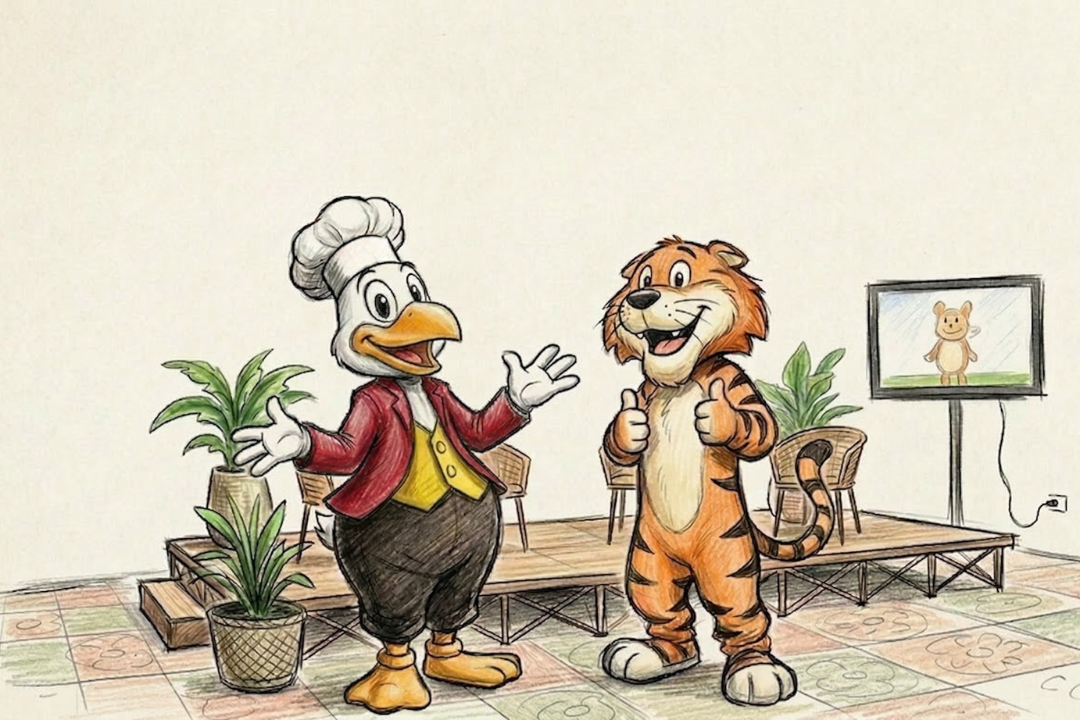
What makes a brand mascot last 50 years? Not just good design but a strategic approach to culture, community, and consistency that turns a simple character into something people actually love.
At the Festival de Animación de El Retiro, two of Colombia's most iconic companies took the stage to share the stories behind their brand characters: Frisby, the beloved fried chicken chain, and Sura, the financial and insurance giant. Their presentations were more than nostalgic; they were a masterclass in long-term character strategy, revealing why mascots aren't just marketing tools but living assets that grow in value over time.
This article distills the key insights from both talks, exploring how El Pollo Frisby and El Tigre de Sura were built, evolved, and turned into cultural institutions—and what your brand can learn from their journeys.
In 1980, Frisby introduced El Pollo Frisby, a character born from the warmth of Colombian community spirit and inspired by the magic of Disney. More than four decades later, he's not just a mascot. He is Colombian pop culture.
The genius behind El Pollo Frisby wasn't a massive advertising budget; it was massive participation. The strategy was deceptively simple: be present at the moments that matter most to Colombians. Carnivals, parades, regional festivals, school events, neighborhood celebrations. Wherever communities gathered, El Poll Frisby showed up.
Crucially, he showed up dressed for the occasion. By wearing traditional Colombian regional outfits, the character signaled respect for the country's rich multicultural identity. In a nation as diverse as Colombia—with distinct Andean, Caribbean, Pacific, and Amazonian cultures—this adaptability created a mascot that felt local everywhere he went.
One of the most surprising revelations from the Frisby presentation was how the character transcended marketing to become a corporate relations tool. Companies began inviting El Pollo Frisby to spend full days in their offices—not to sell chicken, but to lift morale, energize teams, and strengthen business relationships.
This shift from B2C mascot to B2B brand ambassador demonstrates a rare depth of brand equity. When your character becomes useful to other businesses' internal culture, you've achieved something most marketers can only dream of.
In the social media era, El Pollo Frisby evolved again. Today, he operates as a content creator in his own right, with dedicated channels that focus entirely on his adventures, personality, and community interactions without any direct product promotion.
This counterintuitive approach, separating the character's content from the brand's sales messaging, has paid off enormously. Artists, influencers, and content creators actively seek collaborations with El Pollo Frisby, treating him as a peer rather than a corporate spokesperson. His birthday party, where he invited fellow brand characters, became a viral social media moment that generated organic reach no paid campaign could replicate.
From a TV debut to a multi-country 3D ambassador who never ages
In 1972, El Tigre de Sura made his television debut with a clear, powerful message: "We are tigers protecting you." Over 50 years later, that message hasn't changed—because it never needed to.
El Tigre de Sura was designed with a concept that sounds simple but is extraordinarily difficult to maintain: never aging, always preventing risks, always looking after wellbeing. In the industry of insurance, health, and financial services, where trust is the primary currency, this consistency is not just aesthetically pleasing. It is strategically essential.
Sura's team manages the tiger's personality with surgical precision. The rules are strict: he never wears clothing or accessories. The one exception? During the COVID-19 pandemic, El Tigre wore a mask, a move that was both culturally resonant and entirely on-brand for a character whose entire identity is built around protection and prevention.
"He is the reliable friend—the one who drives you home after a wild night. That's not a tagline. That's a carefully managed persona."
El Tigre's journey mirrors the evolution of Sura itself. Originally appearing in television commercials, he gradually climbed what the brand team described as "the corporate ladder," becoming embedded in internal communications and company culture—not just external advertising.
This inward turn is a mark of brand maturity. When an external mascot becomes part of how a company talks to itself, it signals that the character has genuinely become part of the organization's identity, not just its marketing department's toolkit.
Most recently, El Tigre was reactivated as part of Sura's strategic expansion across Latin America. His deployments now include appearances at iconic tourist sites across the region, reinforcing his role as a trusted presence wherever Sura operates—not just in Colombia.
This regional strategy leverages decades of built-up brand equity in Colombia to accelerate trust-building in new markets. In a sense, the tiger carries Colombia's endorsement with him wherever he travels.
Beyond sentiment and nostalgia, both Frisby and Sura presented concrete evidence for why character-led strategies outperform alternatives. Their insights align with a growing body of evidence in brand strategy and consumer psychology.
Brand characters are content machines. They can attend events, react to news, collaborate with creators, and generate social media content without the awkward product-placement energy that plagues branded content. El Pollo Frisby's dedicated channels—which never mention the product—demonstrate that audiences will follow a character they love regardless of the commercial connection.
In crowded markets, brand recognition alone isn't enough. A well-crafted character creates emotional shortcuts; the brain processes familiar characters faster and with more positive affect than abstract logos or taglines. When a Colombian sees El Tigre de Sura, 50 years of "we protect you" is communicated instantaneously.
Characters are an investment that appreciates. While the initial development of a well-executed mascot requires significant creative work, the cost per impression drops dramatically over time as the character becomes self-generating in terms of cultural relevance. A/B testing conducted by both brands has consistently shown that campaigns featuring their characters deliver higher engagement, greater visibility, and stronger ROI compared to campaigns without them.
Perhaps the most powerful effect is what we might call generational inheritance. When a parent who grew up loving El Pollo Frisby brings their child to a Frisby restaurant, and that child meets the character, decades of positive association transfer instantly. The brand doesn't need to earn trust from scratch with every generation; it inherits it.
Miguel Zuluaga
.png)